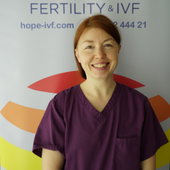
Dr. Christine Schembri Deguara on Why Our Success Rates Stand Out
Malta's first UK-accredited specialist in reproductive medicine shares four years of clinical outcomes — and why world-class IVF no longer requires leaving the island.
The Specialist Behind the Numbers

Dr. Christine Schembri Deguara is the first Maltese physician to have completed the Royal College of Obstetricians and Gynaecologists’ subspecialisation training in reproductive medicine — one of the most competitive programmes in Europe.
Her training path spans fifteen years across London’s leading university hospitals: St. Bartholomew’s, the Royal London, University College Hospital, and the Royal Free. She earned her PhD from Queen Mary University of London in molecular reproductive biology and held consultant posts in both the NHS and on Harley Street before returning to Malta in 2021 to lead HOPE Fertility.
Dr. Deguara is recognised on the UK General Medical Council register, the EU specialist register, and the Maltese Medical Register. She has published peer-reviewed research in minimally invasive gynaecology and endometriosis, presented at international congresses with multiple clinical excellence awards, and served as a faculty lecturer for the RCOG.
“When we opened HOPE in 2022, our mission was to prove that Maltese patients deserve access to the same calibre of care available in the best European centres — without the stress, cost, and disruption of travelling abroad. Four years later, our data proves we’ve achieved that.”
Dr. Christine Schembri Deguara, M.D., Ph.D., MRCOGFour Years of Verified Outcomes
Every cycle performed at HOPE is pre-approved and reported to Malta's Embryo Protection Authority (EPA) — a level of regulatory traceability comparable to the UK's HFEA. There is no selection bias in these figures: they represent every patient treated.
How We Compare with Europe's Best
The ESHRE European IVF Monitoring report covers 923,318 treatment cycles across 41 countries. HOPE's outcomes consistently exceed the top-performing nations in Europe. All ESHRE rates from Table 3 of “ART in Europe, 2020” (Smeenk et al., Human Reproduction, 2025). Fresh ICSI rates = clinical pregnancy per aspiration; FET rates = clinical pregnancy per thawing. HOPE rates are per embryo transfer (ET).
| CENTRE / COUNTRY | FRESH ICSI PREGNANCY RATE PER ASPIRATION | FET PREGNANCY RATE PER THAWING |
|---|---|---|
| ★ HOPE Fertility Malta | 61.8% (per ET) | 55.7% (per ET) |
| Czech Republic | 21.5% | 32.9% |
| Spain | 16.5% | 39.3% |
| Greece | 13.7% | 41.0% |
| ESHRE All-Country Average | 20.0% | 34.9% |
HOPE vs. popular patient destinations
Greece and Spain — two of the most popular IVF destinations for Maltese patients — reported ICSI pregnancy rates of just 13.7% and 16.5% per aspiration respectively in the ESHRE 2020 data. HOPE’s 61.8% per transfer demonstrates that world-class results are available right here in Malta — without the cost, stress, and disruption of travelling abroad.
Donor Egg Programme: Outstanding Results
For patients who require donor oocytes, HOPE delivers exceptional outcomes — consistently exceeding European benchmarks.
The ESHRE 2020 report recorded pregnancy rates of 51.3% per transfer with freshly donated oocytes and 45.7% with thawed oocytes across Europe. HOPE's donor programme exceeds both benchmarks — a testament to our laboratory protocols and our embryologists' expertise.
Safety: Balanced Results, Not Just High Numbers
High pregnancy rates only matter if they come with acceptable safety outcomes. Our miscarriage and multiple pregnancy rates are well within — and in many cases better than — established benchmarks.
Miscarriage Rate
17.8% own eggs — compared with 19.8% across ESHRE 2020 countries. Within the ACOG benchmark range of 10–20% for all-ages IVF populations. Our mean patient age of ~35.5 years places this in expected territory.
Multiple Pregnancy
10.9% (2025 data, own eggs) — matching the ESHRE 2020 European average of 10.9% for fresh IVF/ICSI, and achieved with an average of 1.3 embryos transferred, reflecting our commitment to safe single-embryo transfer when clinically appropriate.
The Laboratory Advantage
Behind every pregnancy rate is a laboratory. HOPE's embryology team — CAP-accredited, one of only three in the EU — consistently operates above Vienna Consensus competency benchmarks.
Polarised Light Microscopy: Spindle Visualisation Technology
HOPE is one of the very few clinics worldwide using polarised light microscopy (PLM) for real-time oocyte quality assessment. This non-invasive technology allows our embryologists to visualise the meiotic spindle — the cellular structure critical for chromosome alignment — before ICSI injection.
Only oocytes confirmed to be at full maturity are selected for injection, virtually eliminating failed fertilisations due to oocyte immaturity. This is a key driver of our 94% fertilisation rate and our exceptionally low 0.1% complete fertilisation failure rate.
Addressing the Elephant in the Room: Do You Need PGT?
Many patients considering treatment abroad do so in the belief that preimplantation genetic testing (PGT-A) is essential for IVF success. The clinical evidence — and our own data — tell a more nuanced story.
What PGT-A actually does — and what it doesn't
PGT-A (preimplantation genetic testing for aneuploidies) screens embryos for chromosomal abnormalities before transfer. It can reduce the number of transfers needed to achieve pregnancy — essentially shortening the time to pregnancy for certain patient groups. However, it does not increase the overall chance of having a baby per stimulation cycle.
A growing body of evidence, including multiple randomised controlled trials, has shown that PGT-A does not improve cumulative live birth rates when all embryo transfers from a single egg collection are considered. What it does is select the embryo most likely to implant on the first attempt — but embryos labelled "abnormal" by PGT-A can sometimes still result in healthy pregnancies, and the biopsy itself carries a small but real risk of embryo damage.
Our results without PGT match centres that use it
Centres worldwide that routinely apply PGT-A typically report pregnancy rates in the 60–65% range per transfer of a tested embryo. HOPE achieves 61.8% per transfer in fresh cycles — without genetic testing — through laboratory excellence, spindle visualisation technology, and individualised clinical protocols.
“PGT-A has its place in reproductive medicine — particularly for patients over 39, those with recurrent pregnancy loss, or couples with known genetic conditions. But for the majority of patients — perhaps 70% or more — our data demonstrates that outstanding outcomes can be achieved through clinical and laboratory excellence alone, without the additional cost, embryo risk, and emotional burden of genetic testing.”
— Dr. Christine Schembri DeguaraWho may benefit from PGT — and what we recommend
For patients where PGT is clinically indicated — typically those over 39, with repeated implantation failure, recurrent miscarriage, or known chromosomal conditions — we openly discuss cross-border treatment options and support patients in accessing the most appropriate care, whether in Malta or abroad.
For everyone else — and this is the majority — the evidence supports that a high-quality laboratory, experienced clinicians, and advanced embryo selection techniques like spindle visualisation can deliver equivalent or better cumulative outcomes, at a fraction of the cost and stress.
Why Travel When the Results Are Here?
For years, Maltese patients and international couples have travelled to Greece, Cyprus, Spain, or the Czech Republic for IVF. Our data now makes a compelling case to stay.